
A local-business website can be beautiful, fast, accurate, and almost useless.
That sounds harsher than it is. The page may do its visible job perfectly. It can explain the service, show the work, answer the first questions, and give a customer a clear way to begin. Then the form submission lands in an inbox nobody checks. The phone rings while the owner is on a ladder. A booking request starts a second calendar. Nobody can tell which page produced the lead. Six months later, the business facts on the site and the facts used by newer AI tools no longer agree.
The failure is not necessarily the website. The failure is the handoff.
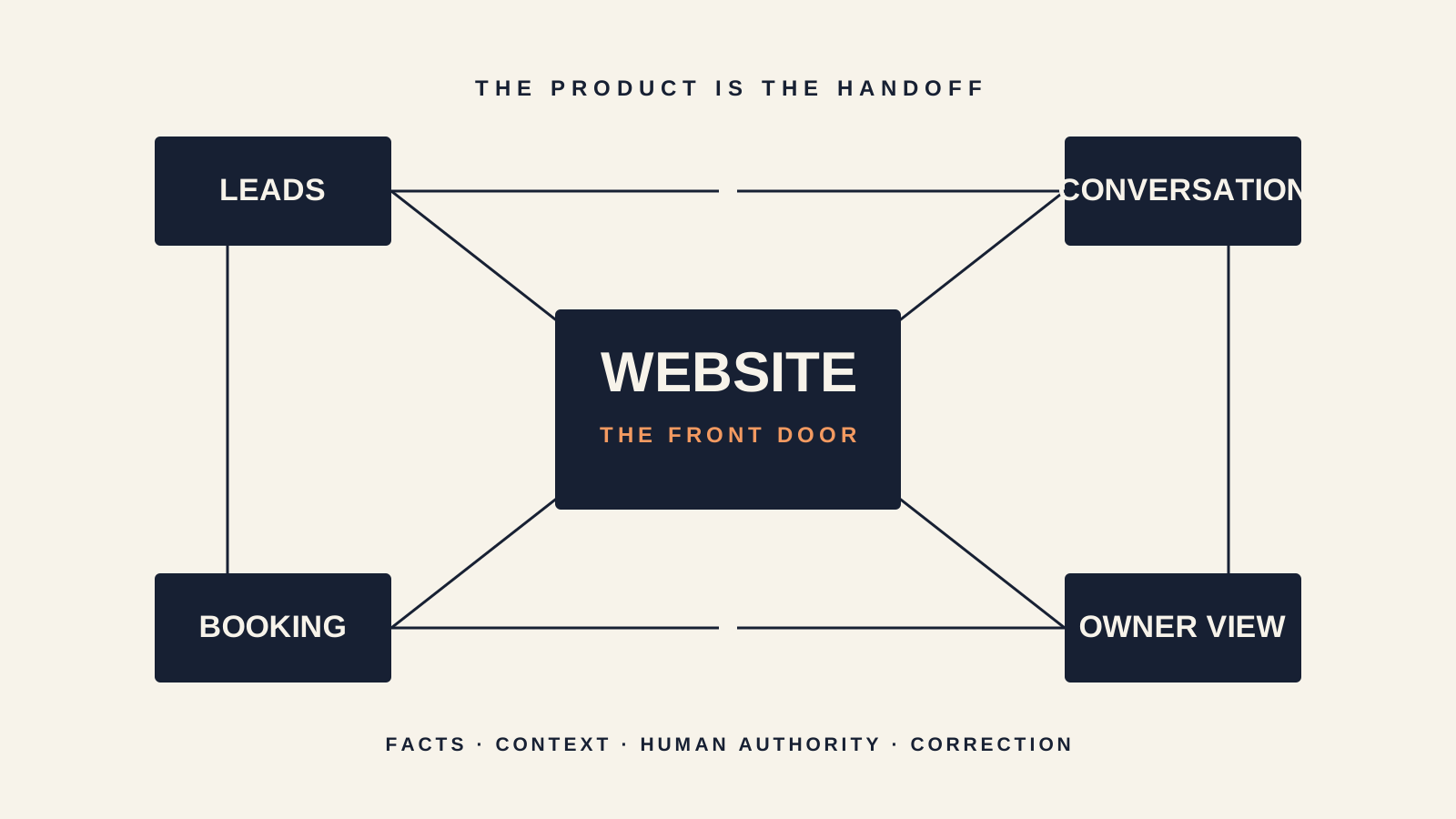
That is the working thesis behind Local Business Factory, a project owned by this magazine’s publisher. The experiment begins with a structured brand record and uses it to prepare a local-business site plus the systems around it: leads, conversation, analytics, booking, an owner view, a working knowledge base, and local search information.
This is not independent coverage of that project, and it is not a report of business outcomes. No claim in this article says the system produced more revenue, more leads, faster response, or less work. Those claims would require dated receipts, a measurement method, and a comparison that does not yet appear here.
What we can inspect is the architecture—and the argument it makes about what a website is for.
The front door and the building
For years, “build a website” was a coherent purchase. A business needed pages. The builder made the pages. A contact form and an analytics tag might be attached at the end.
That model still describes the visible artifact, but it misses the operating path behind a customer’s decision.
Consider the customer who wants a contractor to look at a damaged roof. The page has to establish the service area, scope, evidence, and next step. The request then has to enter a lead system with enough context to be useful. A person—or a carefully bounded automated assistant—has to respond without inventing price, availability, insurance coverage, or a promise. If the request becomes an appointment, the calendar needs one accountable source. Later, the owner needs to understand whether the system is producing useful work or simply collecting activity.
The same pattern appears in different clothes at a fitness studio, a professional office, or a neighborhood shop:
- A customer discovers a trustworthy public fact.
- The customer chooses a clear action.
- The action enters a system that can preserve context.
- A human receives the decisions only a human should make.
- The business can see what happened without reconstructing the trail from five inboxes.
The website is essential to that path. It just is not the whole path.
One source of truth—within limits
Local Business Factory’s declared starting point is a brand-dna.json file: a structured record of identity, services, audience, voice, offers, contact information, and other business facts.
The appealing part is reuse. A verified fact should not need to be typed independently into the site, a chat system, an owner dashboard, and every future tool. Shared source data can reduce drift and make a correction travel farther.
The dangerous part is also reuse. A wrong service area, an exaggerated credential, or an outdated offer can spread just as efficiently.
So “one source of truth” cannot mean “one file gets to decide everything.” A useful system needs categories:
- facts the owner has verified and machines may repeat;
- observations that are dated and may become stale;
- judgments that belong to editorial or business staff;
- promises—price, schedule, outcome, availability—that require current human authority;
- private information that should never become public copy.
The factory is most interesting where it treats those boundaries as part of the product. It is least interesting when it behaves like a page generator with more integrations.
The work should be visible
The project’s own art-direction document offers a useful line: a software factory’s real photography is its artifacts.
That idea matters beyond design.
An agency can promise strategy, automation, intelligence, and growth in a single paragraph. A reader cannot inspect any of those nouns. A system map is better. A redacted lead handoff is better. A browser capture with a date and an honest status is better. A repair ledger that shows what broke after launch is much better.
This is also how an owned-media article can avoid becoming an advertorial. The proof object is not a glowing description of the publisher. It is the work:
- the brand record and the fields it is allowed to control;
- the website as the public interface;
- the lead path and its failure state;
- the conversation boundary where an assistant must stop;
- the booking source that prevents duplicate promises;
- the analytics receipt and what it cannot prove;
- the owner view that turns scattered events into decisions;
- the knowledge record that needs a correction path.
None of those artifacts proves that a customer is happy or a business is better off. They do let a reader evaluate whether the architecture matches the problem.
AI raises the cost of vague facts
The phrase “getting local businesses into the AI age” can become empty very quickly. Adding a chat bubble is not a strategy. Generating more copy is not the same as making a business easier to understand.
The more practical question is this: can a machine accurately determine what the business does, where it works, what evidence supports that, and what a customer should do next?
That requires clear public information, structured facts, current sources, and disciplined refusals. An assistant that answers every question confidently is dangerous. A useful one knows when the record is missing, when a fact is stale, and when the next action is a human handoff.
For the owner, AI may be most valuable in the unglamorous middle:
- carrying context from the first inquiry;
- drafting a response without sending it;
- finding the right business fact without searching old messages;
- surfacing a missed follow-up;
- showing which system needs attention;
- preparing a decision while leaving authority with a person.
That is not a robot replacing the relationship. It is machinery protecting the relationship from administrative loss.
It is also only a thesis until specific workflows are measured.
Where the factory can go wrong
Repeatability creates leverage. It also creates sameness.
If every business receives the same page rhythm, the same rounded cards, the same polite claims, and the same generic photography, the factory has optimized away the reason a customer would remember the business. If every available integration is switched on, the owner inherits a control panel instead of a simpler operation. If a shared template hides broken seams, speed becomes a way to reproduce defects.
The project’s own design work names this tension as industrial repeatability versus one-of-one craft. That is the right tension to publish because it cannot be resolved with a slogan.
A responsible build needs at least three separations:
Shared chassis, distinct face. Security, forms, analytics, and deployment can be systematic. The public expression should come from the business’s real materials, voice, work, and customers—not a factory costume.
Prepared action, human authority. Software can prepare a lead record, response, task, or recommendation. It should not invent availability, approve outreach, claim a visit, or make a business promise.
Capability, evidence. A connected analytics system is a capability. A measured improvement is evidence. The first cannot be written as the second.
Future “Built Here” stories should test those separations against real receipts. One should examine a failed design round. Another should follow a missed-call handoff with consent. Another should audit whether public business facts are ready for AI discovery. The most valuable article may be the one titled “What the Factory Got Wrong.”
A better definition of done
The website is still the front door. It deserves craft, speed, clarity, accessibility, and a point of view.
But the product is the customer’s path through the building:
- Can they understand the business?
- Can they begin without guessing?
- Does their context survive the handoff?
- Does a human retain authority over the promise?
- Can the owner see what needs attention?
- Can the public facts be corrected when they change?
Local Business Factory is an attempt to build that larger path. This first article documents the map, not the destination. The next useful proof will not be another list of features. It will be one complete, consented workflow with dates, artifacts, a measured result, and the seam that still failed.
That is the standard an owned project should have to meet before promotion becomes a story.
Source note: This article is bounded to the Local Business Factory repository’s README and art-direction contract, plus this magazine’s Publishing OS. Their source fingerprints and the unsupported outcomes excluded from this piece are recorded in the repository’s built-here-2026-07-22 editorial source snapshot.
The Weekly Scoop
Get Fort Collins ice cream news, new flavor alerts, and seasonal guides delivered to your inbox.
Weekly · Free · Unsubscribe anytime