
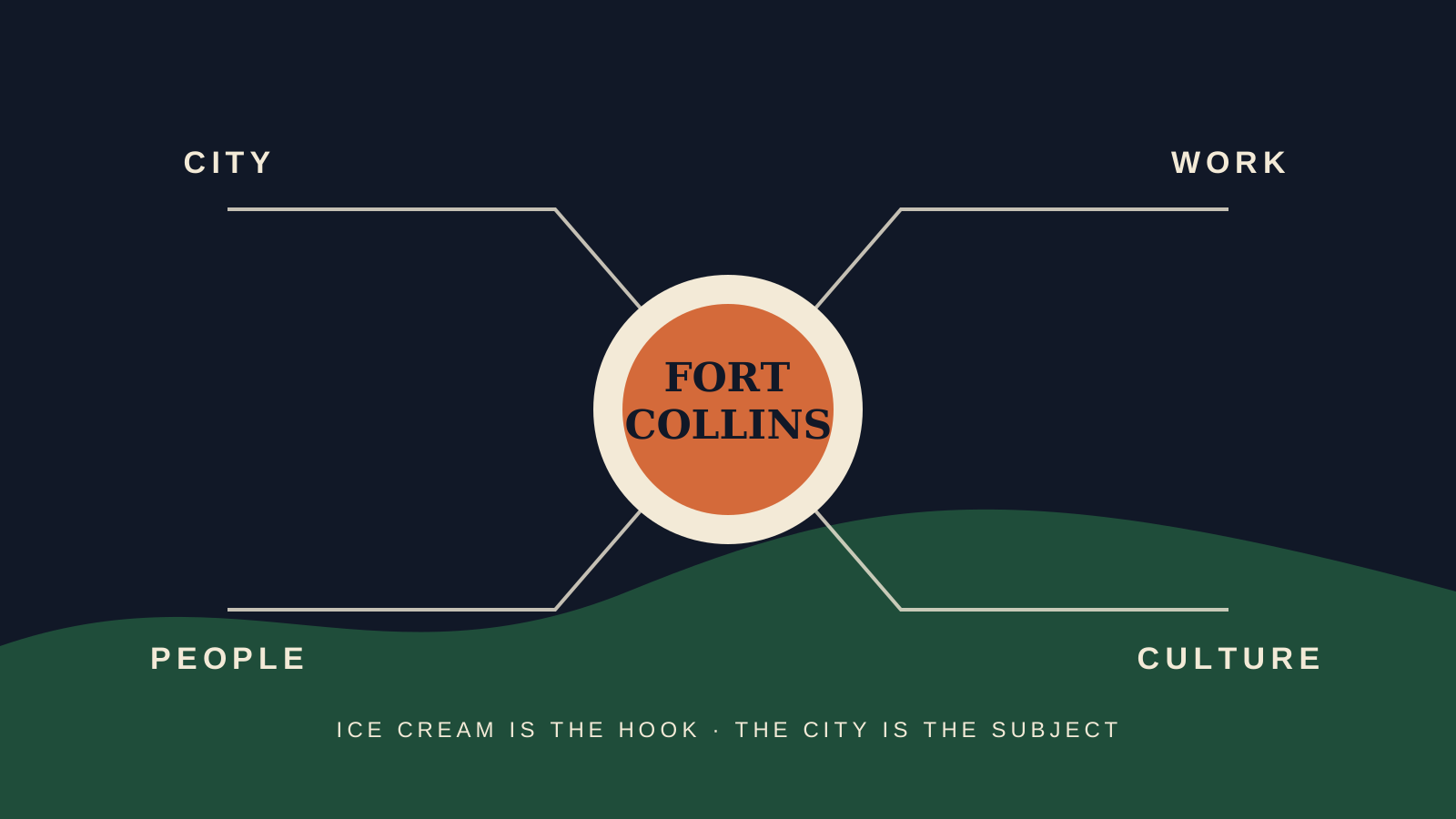
The name on the masthead makes a clear promise: we care about ice cream. We care about the shops, the people who make the product, the rituals that form around a counter, and the small decisions that separate a useful guide from a pile of adjectives.
But a subject can be both a specialty and a trap.
If every story begins with a cone, every photograph reaches for a scoop, and every calendar slot asks for another seasonal flavor roundup, the magazine becomes smaller than the city that gives it meaning. The result may be consistent, but it is not especially curious. It cannot surprise the reader because the answer is visible before the page turns.
So we are making the editorial promise more precise:
Ice cream is the hook. Fort Collins is the subject.
That sentence does not retire the scoop. It gives the scoop a proper job.
What stays
Ice cream remains a signature department. Rankings should show their criteria. Reviews should distinguish sourced menu facts from actual field tasting. Dietary guides should treat cross-contact as a serious reporting question, not a reassuring paragraph assembled from a menu. Trails should be walked. Prices should be dated. A claim that something is “best” should require a comparison method the reader can inspect.
That is more demanding than publishing another list, which is exactly the point.
We would rather report one product all the way through—its ingredients, process, maker, price, service, and place in the city—than publish five thin variations on “what to order this month.” The narrower subject can produce the deeper story.
The old archive did not consistently meet that standard. Some articles combined plausible local details with recommendations, safety language, availability, or implied experience that did not carry enough evidence. Those pieces are now held for new reporting. A file in a content folder is not proof, and a search-friendly headline is not permission to publish.
What opens up
Fort Collins supplies more questions than any one food category can hold.
Where can someone sit in real shade on a hot afternoon? What does graduation weekend look like from the point of view of a worker, a family, and a small operator? Which public decisions change an ordinary block? What does it cost to open a holiday pop-up before the first customer arrives? How does a one-person company decide which work to automate and which promises must remain human?
Those are magazine questions because each one combines place, people, evidence, and a choice the reader can use.
Our forward calendar now has five lanes:
- Signature food: deeply reported reviews, rankings, processes, and service pieces.
- City and civic life: public places, neighborhood change, useful records, and the decisions that shape a day here.
- Local builders: the people making shops, services, events, objects, and organizations work.
- Work and the future: what new tools, especially AI, change for local businesses and customers.
- The Publisher’s Lab: clearly disclosed reports from projects owned by this magazine’s publisher.
The target is not an equal number of stories in every bucket. It is a healthy issue rhythm. Signature food should occupy roughly a quarter of the commissioning calendar, not every available slot. A reader should be able to move from a reported scoop to a map, a builder’s ledger, a civic question, and a useful weekend plan without feeling that five unrelated subjects have been forced into one flavor.
Promotion has to earn its page
Owned media can discuss the publisher’s own work. Pretending otherwise would be artificial. The important question is whether the coverage gives the reader something more useful than an advertisement.
Our rule for a publisher project is:
Reader problem → real experiment → visible artifact → measured result → failure or limitation → clear disclosure → optional invitation.
If the piece has no visible work, it is a claim. If it has no limitation, it is promotion. If it hides the ownership relationship, it breaks the reader’s trust. If the only payoff is a sales link, it did not earn an editorial page.
This is why a future story about Local Business Factory should not say, “We build websites for local businesses,” and stop there. It should show the system map, explain why the website is only one part of the operating problem, name what the system cannot safely automate, include a repair or failed assumption, and separate its architecture from any outcome that has not been measured.
The conflict will be printed near the top. The optional invitation comes last, if it belongs at all.
The pictures should come from the story
The visual reset matters too.
A cone is not punctuation. A scoop is not a universal background texture. Generic dessert imagery on a story about public space, work, technology, or a neighborhood tells the reader that the article was decorated after the fact.
The better image is usually evidence:
- a map that clarifies a route;
- a document that shows a decision;
- a tool or workspace that reveals process;
- a repeated view of one place across time;
- a system diagram that makes an invisible handoff visible;
- a rights-cleared photograph of the actual reported subject.
Professional magazines use art to pace an issue, but the art changes with the job of the page. Our own reference studies made the same lesson plain: a local weekly can contain news, advice, music, listings, events, and food because those sections do different work, while strong visual systems avoid repeating placeholder art as if repetition alone creates identity.
The identity comes from judgment, not props.
What “content rich” means here
Length is not depth. A 1,200-word article can still be empty if every paragraph paraphrases one operator’s website. A 500-word service piece can be rich if it answers a precise question with current sources, a useful structure, and honest limits.
For a normal feature or guide, our floor is at least two distinct credible sources. Rankings, dietary safety, medical language, legal claims, and contested subjects demand more. Every section should perform a different reader job. The nut graf should tell the reader what question is being answered. The ending should leave behind a choice, a route, a question to ask, or a next action.
Most important, reporting modes have to stay visible inside the prose. A source can tell us what an operator lists. It cannot create a visit. A public directory can surface a lead. It cannot create a verdict. Software can prepare a draft. It cannot conduct an interview that did not happen.
That discipline will sometimes produce fewer stories. It should produce better ones.
The next page
The first piece in the new “Built Here” lane examines Local Business Factory, a project owned by this magazine’s publisher. It begins with a simple argument: the website is no longer the whole product. The interesting work is in the handoffs behind it—and in the places those handoffs fail.
After that, the calendar gets wider: shade, streets, operating ledgers, one-person studios, graduation logistics, one fully reported scoop.
The name of this magazine will keep giving us a memorable way into Fort Collins. It no longer needs to be a fence around what we are allowed to notice.
Source note: This publisher’s note draws on the magazine’s saved Publishing OS and its structural studies of Boulder Weekly and three national titles. The source fingerprints and the note’s limits are recorded in the repository’s built-here-2026-07-22 editorial source snapshot.
The Weekly Scoop
Get Fort Collins ice cream news, new flavor alerts, and seasonal guides delivered to your inbox.
Weekly · Free · Unsubscribe anytime